










Building or renovating near ravines, shorelines, or valley lands in Toronto involves more than standard zoning checks. Properties regulated by the Toronto and Region Conservation Authority (TRCA) are subject to additional location and setback rules that directly affect where buildings can be placed on a lot.
One of the most critical constraints is the shoreline hazard limit or stable top-of-bank. These boundaries are established to protect public safety, prevent erosion, and preserve natural landforms. Understanding how these limits affect building location, floor area calculations, and setbacks is essential before moving forward with any design or permit application.
This guide explains how these zoning rules apply in Toronto, when exceptions exist, and what property owners need to know to avoid costly redesigns or permit delays.
Start Your Project with Confidence
At Land Signal, we assist with construction and renovation permits, as well as Garden House and Laneway Suite designs. Let our experts guide you through every step.
What Is a Shoreline Hazard Limit or Stable Top-of-Bank?
A shoreline hazard limit or stable top-of-bank marks the boundary beyond which land is considered unsafe for regular development due to erosion, slope instability, or flood risk. On properties regulated by TRCA, this line is formally determined and confirmed by the authority.
Once this limit crosses a lot, zoning restrictions immediately apply to portions of the property located below it.
Where Buildings Are Not Permitted
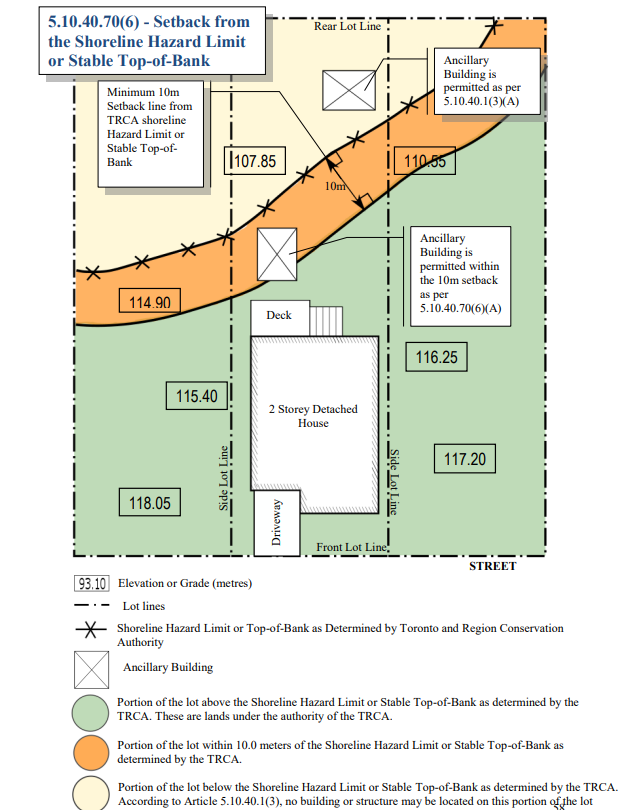
Under Zoning By-law 5.10.40.1(3), if TRCA determines that a shoreline hazard limit or stable top-of-bank crosses a lot, no building or structure may be located below that line, except in very specific situations.
Permitted Exceptions
Only the following uses are allowed below the hazard limit:
- Ancillary buildings or structures on residential lots
- Buildings required for conservation works
- Public utilities or transportation-related structures
These restrictions do not apply to properties located within the Open Space Zone category.
How TRCA Review Fits into the Process
Before zoning compliance can be confirmed, the property must be reviewed by TRCA.
Step-by-step review process
1. Zoning review identifies TRCA jurisdiction
The zoning examiner confirms whether the property is regulated by TRCA and directs the applicant accordingly.
2. TRCA confirms hazard limits
TRCA works with the applicant to establish the shoreline hazard limit or stable top-of-bank location.
3. Official confirmation
TRCA stamps the confirmed limit on a site plan or plan of survey. This approved line becomes the basis for zoning review.
This confirmation is mandatory unless the property is in an Open Space Zone.
Floor Area Calculation Rules Below the Hazard Limit
Even when construction is restricted, zoning still affects how density is calculated.
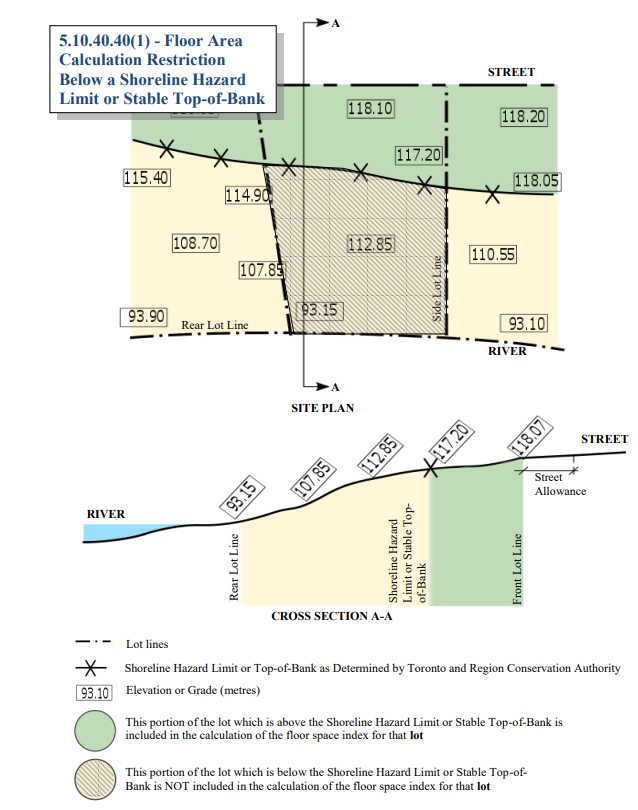
According to Zoning By-law 5.10.40.40(1), any portion of a lot located below a confirmed shoreline hazard limit or stable top-of-bank must be excluded from Floor Space Index (FSI) calculations.
This means:
- That portion of land cannot be used to increase permitted floor area
- Buildable density is calculated only on the remaining safe portion of the lot
This rule often reduces development potential on affected properties and must be considered early in design.
Minimum Setback Requirements
In addition to location restrictions, setbacks apply.
Under Zoning By-law 5.10.40.70(6), buildings and structures must be set back a minimum of 10 meters from the confirmed shoreline hazard limit or stable top-of-bank.
Exceptions remain limited to:
- Ancillary residential structures
- Conservation, utility, or transportation uses
Again, this setback rule does not apply to Open Space Zone properties.
Read Also: Front Yard Setback Averaging in Toronto
Separation from Hazard Limits on Adjacent Properties
Zoning also controls proximity to hazard limits located on neighboring lots.
Under Zoning By-law 5.10.40.80, buildings must maintain a minimum 10-metre separation from a shoreline hazard limit or stable top-of-bank located on an adjacent property, unless the same limited exemptions apply.
Lawfully Existing Buildings
Existing conditions are treated differently.
If a lawfully existing building is already located below a shoreline hazard limit or within a required separation distance:
- The building is permitted to remain
- Alterations or replacement are allowed
- The structure cannot increase its height, length, or width
- Any replacement must not move closer to the hazard limit
This provision allows reasonable upgrades without expanding risk.
When a Minor Variance Is Required
If a proposed building or structure does not qualify for an exemption and is located below a TRCA-confirmed hazard limit, a zoning by-law minor variance is required.
Important clarification:
- TRCA approval alone does not remove the need for a minor variance
- Both approvals are required when zoning relief is necessary
This is a common point of confusion and a frequent cause of application delays.
How Land Signal Can Help
Understanding hazard limits and zoning setbacks requires more than reading diagrams. Land Signal translates these technical rules into clear, actionable guidance.
Land Signal helps by:
- Identifying the exact hazard line location on your property
- Determining which portions of the lot are excluded from floor area
- Calculating realistic buildable envelopes early
- Coordinating zoning interpretation with conservation constraints
- Supporting permit-ready planning decisions before design costs escalate
This approach reduces risk and gives property owners clarity from the start.
Read Also : Home Building Cost Calculator Ontario
Final Thoughts
Location restrictions tied to shoreline hazard limits and stable top-of-bank boundaries play a decisive role in what can be built on many Toronto properties. While the rules may seem complex, they follow a consistent logic focused on safety, environmental protection, and responsible land use.
From an expert perspective, most project setbacks occur not because development is impossible, but because these constraints are discovered too late. When hazard limits are identified early and applied correctly, property owners can design confidently and avoid unnecessary revisions.
Understanding these zoning rules upfront is not just compliance. It is smart planning.
Sources
Lorem ipsum dolor sit amet, consectetur Lorem ipsum dolor sit amet, consectetur adipiscing elit. Ut elit tellus, luctus nec ullamcorper mattis, pulvinar dapibus leo. adipiscing elit. Ut elit tellus, luctus nec ullamcorper mattis, pulvinar dapibus leo.Lorem ipsum dolor sit amet, consectetur adipiscing elit. Ut elit tellus, luctus nec ullamcorper mattis, pulvinar dapibus leo.Lorem ipsum Ut elit tellus, luctus nec ullamcorper mattis, pulvinar dapibus leo.
- Lorem ipsum dolor sit amet, consectetur adipiscing elit. Ut elit tellus, luctus nec ullamcorper mattis, pulvinar dapibus leo.
- Lorem ipsum dolor sit amet, consectetur adipiscing elit. Ut elit tellus, luctus nec ullamcorper mattis, pulvinar dapibus leo.
- Lorem ipsum dolor sit amet, consectetur adipiscing elit. Ut elit tellus, luctus nec ullamcorper mattis,
- pulvinar dapibus leo.Lorem ipsum dolor sit amet, consectetur adipiscing elit. Ut elit tellus, luctus nec ullamcorper mattis, pulvinar dapibus leo.
FAQ
Yes, except where specific exemptions apply. Open Space Zones are treated differently.
Not on its own. A zoning by-law minor variance may still be required.
Yes. Lawfully existing buildings may remain and be altered or replaced, provided their dimensions are not increased.
No. It is excluded from floor area calculations under the zoning by-law.
The Toronto and Region Conservation Authority determines and confirms shoreline hazard limits and stable top-of-bank lines.