







Installing a sign in Toronto involves far more than design and placement. The City enforces its Sign By-law with precision, and many applicants face delays because of missing documents, incorrect drawings, or confusion about sign classifications. These setbacks affect business owners, property managers, and contractors who rely on timely signage to launch or advertise operations.
Unapproved signage can lead to fines, removal orders, and complications with future property improvements such as building permits or renovation permits. This guide provides an overview of the requirements so applicants can prepare their applications, avoid common mistakes, and secure approval efficiently.
Start Your Project with Confidence
At Land Signal, we assist with construction and renovation permits, as well as Garden House and Laneway Suite designs. Let our experts guide you through every step.
Understanding the Toronto Sign By-law
Toronto’s Sign By-law (Chapter 694 of the Municipal Code) governs:
- Sign sizes and dimensions
- Heights and placement on properties
- Illumination and lighting standards
The first step is determining your sign type:
- First Party Sign: Advertises goods or services offered at the same property.
- Third Party Sign: Advertises goods or services not provided on the property. These require additional documents and undergo more rigorous review.
This distinction determines which forms, drawings, and approvals are required.
First Party Sign
A sign that advertises goods or services offered at the same property.
Third Party Sign
A sign that advertises goods or services not provided on the property.
These require additional engineering documents and more rigorous review. Understanding this distinction determines which forms, drawings, and approvals are required.
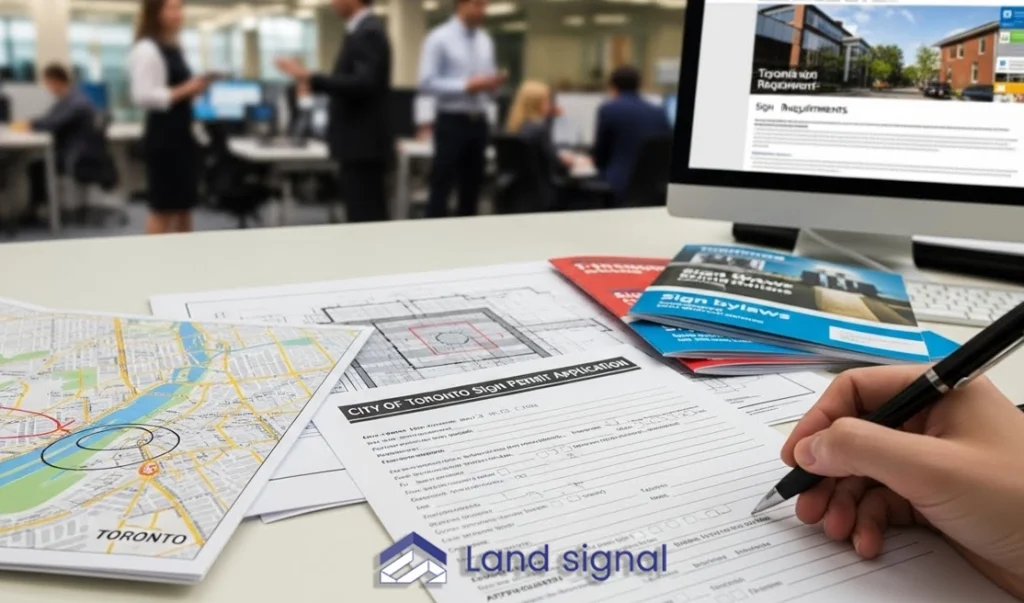
Required Documents and Drawings
1. Application Form
First Party Signs: Application for a Permit to Construct or Demolish
- Third Party Signs: Third Party Sign Permit Application
- If the applicant is not the property owner, a signed owner authorization letter may be required.
2. Technical Drawings
All applications must include scaled, signed, and dated drawings showing:
- Sign dimensions
- Materials and structural details
- Mounting or ground installation method
- Electrical details if illuminated
- Exact location on the building or property
3. Engineering or Architectural Stamps may be required when:
- Ground signs exceed 7.5 m in height
- Projecting signs weigh more than 115 kg
- Roof signs have any face larger than 10 m²
- Signs are attached to a parapet wall
4. Additional Documents (Case Specific) which may be required:
- Tree Declaration (for ground signs)
- Commitment to General Review by an engineer or architect
- Site Plan by Ontario Land Surveyor (OLS) for Third Party signs, showing property lines, setbacks, distances to intersections, nearby signs, and zoning districts
Submitting Your Application
- Submit all documents in PDF format by email to [email protected].
- Review times:
- Non-heritage properties → 3 business days
- Heritage properties → not eligible for 3-day turnaround
- Applications with 4+ signs → up to ten business days
Permit Fees
- Fees vary by sign type and size.
- Fees are between $34.87 and $41.81 per square metre of sign face area
- Minimum fee: approx. $309.30
- Fees payable by credit card over the phone (416-392-8000).
- Application review begins only after payment is received.
Tracking Your Application
- Fewer than 3 signs → 3 business days
- More than 3 signs → 10 business days
Applicants can monitor progress by:
- Contacting the assigned examiner
- Using the City’s online building permit status page
How LandSignal Helps
Completing a Toronto sign permit application requires accuracy, technical preparation, and knowledge of the Sign By-law. LandSignal supports applicants by matching you with qualified professionals who can:
- Review sign classification and applicable sign bylaw requirements
- Coordinate professional drawings and engineering stamp
- Prepare supporting documents
- Submit complete packages on behalf of clients
- Track applications through every review stage
This is valuable for property owners managing multiple approvals, such as building permits or commercial renovation projects.
Read Also:
Conclusion
Securing a sign permit in Toronto requires strict adherence to the Sign By-law, complete technical drawings, correct forms, and timely fee payment. When prepared correctly, the process is predictable and can proceed through either standard or expedited review.
The two most critical success factors are:
- Accurate documentation
- Complete details of the proposed sign
By preparing thoroughly and seeking qualified support when needed, property owners can protect their investment, maintain compliance, and avoid costly delays.
FAQ
Most permanent commercial signs do. Only small temporary signs that meet City exemptions may not require a permit.
Yes, but they must provide a signed authorization letter from the property owner.
They verify structural safety when signs involve load-bearing elements, elevated installations, or electrical components.
Standard processing takes about ten business days. Fast Track approval takes two days when all requirements are met.